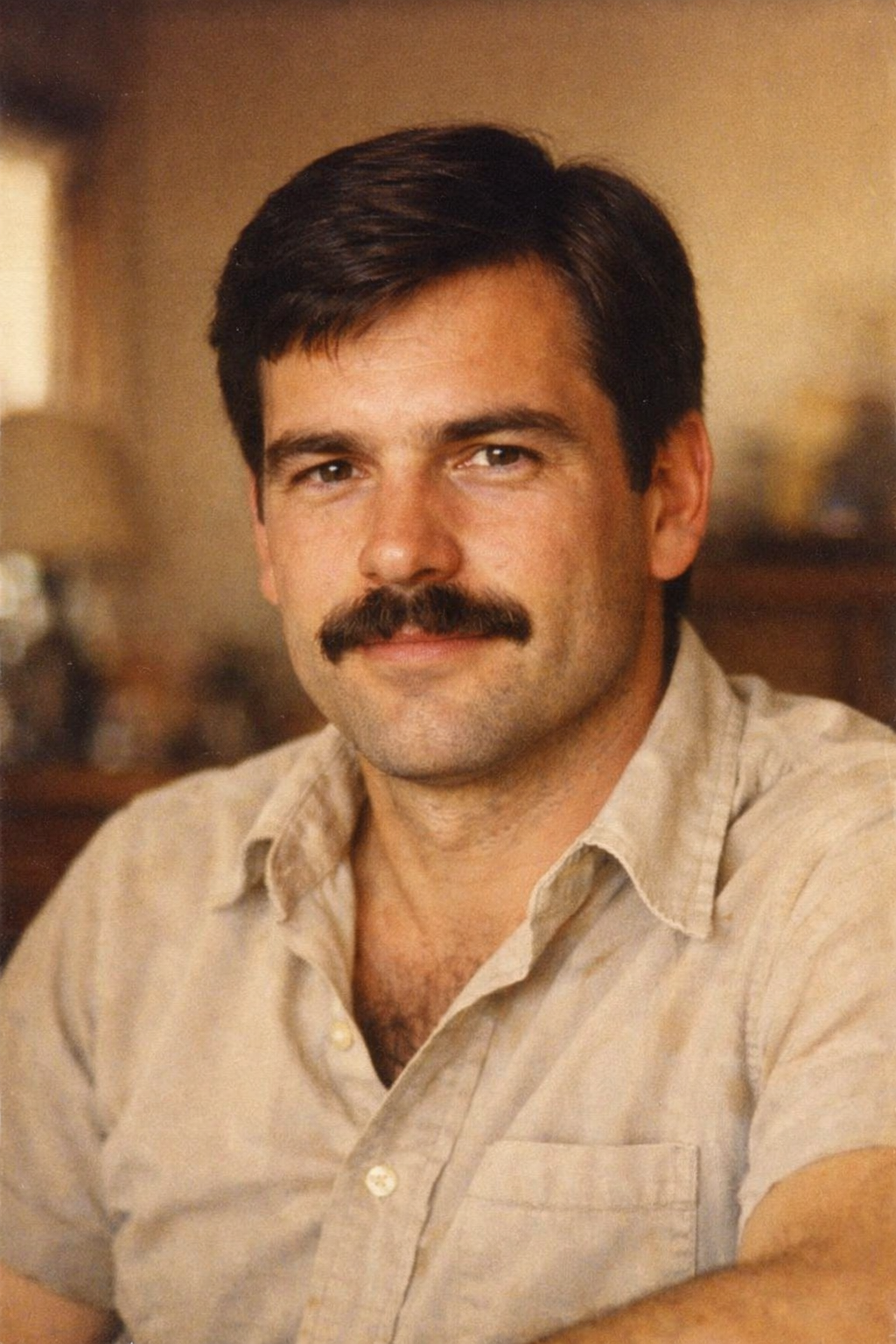
What follows are Jonathan's recollections about childhood, where he came from, his earliest memories, and the people who shaped him.
I grew up in Lowell, Indiana, a small town tucked in the northwestern corner of the state, close enough to Chicago that on a clear night you could see a faint glow on the horizon, but far enough away that we lived in our own quiet world. What I remember most is the space of it, the open fields, the way corn rows stretched to the horizon in summer, the particular smell of a grain elevator on a hot August day. My father worked at one of those elevators most of my boyhood, and when I'd walk by I could always find him by that smell. Lowell wasn't a place that asked much of you, and maybe that was part of its charm. Friday nights in the fall meant high school football. Summers meant the lake and fireflies. People knew each other not just by name but by family, whose son you were, whose grandchild. I didn't fully appreciate what that meant until I left.
I must have been three or four. It was winter, and my mother was ironing in the kitchen with the radio on, some big band music, I think. I remember the hiss of steam and the way the kitchen windows had fogged over completely. I'd drawn something in the condensation with my finger, probably just scribbles, and she came and looked at it and said, "Oh Jonathan, you made a masterpiece." I didn't know what that word meant, but I knew from her tone it was something good. I've thought about that moment more than makes any logical sense. I think it was the first time I understood that someone could make something out of nothing and have it matter to another person.
We were modest by every measure, money, ambition, footprint in the world. My parents, my younger sister Diane, and me in a two-bedroom house on Elm Street. My father worked; my mother kept the house and raised us and made sure we said grace and did our homework. We weren't a family that talked much about feelings, but we were a family that showed up. Supper at the table every night. Church on Sundays. Road trips to visit my grandparents in the summer. It was the kind of family that was easy to take for granted when you were young and that you'd give almost anything to have back once you're older. I was lucky in ways I only understand now.
My mother, without question. Dorothy William was a schoolteacher before she married my father, and even after she stopped teaching in a classroom, she never stopped teaching at home. She read to me every night until I was old enough to be embarrassed about it, and then I pretended to be embarrassed but was secretly glad she kept going. She had a deep, unshakeable belief that education was the thing that made a life larger, and I absorbed that belief so completely that by the time I was a teenager I couldn't have told you where her conviction ended and mine began. My father, Robert, was a quieter influence but a steady one. He worked hard, came home tired, never complained. He had a kind of dignity about ordinary work that I've tried to carry with me. And there was my fourth-grade teacher, Mrs. Hartman, who kept me after school one day not because I was in trouble but because she'd noticed I liked to read and wanted to give me a stack of books she thought I'd love. That gesture changed things for me. I didn't forget it. I don't think I ever will.
In Jonathan's own words.
I was seventeen when my family moved from Lowell, Indiana to Scottsdale, which meant my sixteenth year was spent saying goodbye to everything I knew, and my seventeenth was spent learning how to exist without it. What I remember most about that version of myself is the particular loneliness of being a reader in an unfamiliar place. I didn't know the social architecture of the new school, didn't know who the safe people were or the dangerous ones, and instead of finding out I read. A lot. Whatever was assigned and then whatever I could find beyond it. If my closest friends from that period described me, they'd have to be honest and say I was easy to like but hard to really know. I was agreeable, interested in other people, good at asking questions and listening to the answers. What I didn't know how to do was let people see that I was sometimes uncertain, sometimes scared, sometimes unsure whether I'd made the right choices yet. That took years. I learned it, eventually. Carol helped.
Somewhere between sixteen and eighteen I decided I wanted to be a writer. I kept notebooks, read everything that came to hand, and was convinced that if I could just find the right sentence, I'd be able to say something true about the world. I told my mother this, and she encouraged me in the way she encouraged everything, seriously, with book recommendations. I told my father this, and he said something like, "Writers don't make much of a living." He wasn't wrong. He also wasn't quite hearing what I was saying. What I became instead, or alongside, depending on how you look at it, was a teacher of writing, and of reading, and eventually a principal and superintendent whose job was to build the conditions under which those things could happen for others. I didn't stop believing in the original thing. I just found a different form for it. Some part of me still thinks in terms of sentences. I still notice when a sentence is good and feel something small but real in response. That never left.
There was a girl named Susan Farrow I knew my first two years at Arizona State. We weren't romantic, though I think one of us might have wanted to be at various points. She was from Phoenix, sharp in a way that made her impatient with people who weren't trying, and she was the first person who read something I wrote and told me, directly and without kindness padding, exactly what wasn't working about it. That's the friendship I remember most from those years. Not because it was the most comfortable, it wasn't, but because it was the most useful. She had no interest in telling me I was good when I wasn't. I needed that. I'd had plenty of encouragement from people who loved me; what I needed was someone who could read my work the way a stranger would. We lost touch after I transferred to San Diego State. I never found out what became of her, and for a long time I felt a vague guilt about that, the particular guilt of having taken something valuable from someone and then moved on. I hope she found people who read her work the same way she read mine.
I was in a phone booth in San Diego, one of those old glass-and-metal booths outside a drugstore near the university, calling my parents to tell them I'd accepted my first teaching position, seventh grade English in Chula Vista. It was 1971. My father listened, and when I was finished, said something like, "Well. That's a decision." He meant it as an observation, not a judgment, but I heard the ambivalence in it. What I remember is how I felt after I hung up. Not triumph, exactly. Something heavier and quieter than that. The weight of having committed, of having said in effect: this is the direction of my life, and I'm choosing it with clear eyes. Before that call, all of my choices were still theoretical. I hadn't cost myself anything yet. After that call, I'd traded a set of other possibilities for this one, and I knew it, and I was glad. That phone booth is where I became, in some essential sense, the person I was going to be.
This is Jonathan's account of the life he built, the work he did, the risks he took, the hardest chapters, and the moments he would return to if he could.
I spent my entire career in education, forty years of it, give or take. I started as a seventh-grade English teacher in Chula Vista, just south of San Diego, right after finishing at San Diego State. Then came middle school and high school positions, eventually a principalship in the Scottsdale district after Carol and I decided to put down roots in Arizona. And then, later than I'd expected and after more committee meetings than any person should endure, superintendent of a mid-sized district in the East Valley. People ask which role I loved most, and the honest answer is teaching. There's nothing quite like watching a kid who thinks he's bad at something discover that he isn't, that he just hadn't been taught the right way yet. That moment of realization on a student's face is, I'd argue, one of the finest things a human being gets to witness. The principal and superintendent roles mattered, but they were about creating the conditions for other people to have those moments. Important work, but one step removed from the thing that made me want to do it in the first place.
Leaving Indiana was the first one. I was seventeen and headed to Scottsdale with my family and it felt enormous at the time. The second was choosing teaching as a career. In 1971, my father gently pointed out that teachers didn't make much money, as if this were information I might not have come across. He wasn't wrong, but I'd decided the thing I wanted most was to do work that felt like it mattered. I've never once wished I'd chosen differently. The third risk was asking Carol to marry me after knowing her for nine months. We were twenty-three years old. Everyone said we were rushing. We were, a little, but I knew. Some things you just know.
Losing Carol. She was diagnosed with breast cancer in 2001, and after two years of fighting with more grace than I'll ever be able to adequately describe, she died in the spring of 2003. She was fifty-three years old. I don't have a clean answer for how I got through it. I went to work because work was familiar and familiar felt like solid ground. I leaned on Michael and Karen and David more than I probably should have, they had their own grief and I sometimes forgot that. I walked a great deal, which sounds trivial but wasn't. And I had friends and colleagues who showed up in all the small ways that turn out to be the large ways. One of my assistant principals brought dinner to the house every Friday for a year. She never made a fuss about it. Just left it at the door. I've never forgotten that. What I didn't do was pretend I was fine when I wasn't. I think that was the right choice. Grief is not a problem to be solved. It's a passage to be moved through.
The years when our children were young, Michael in grade school, Karen just starting to walk and talk, David a baby. We were in a small house in Chula Vista, Carol was teaching part-time, money was tight, the future was entirely unwritten. I remember bath time and bedtime stories and Sunday morning pancakes and a kind of chaos that felt, even in the middle of it, like something precious. I've come to believe that's one of the gifts of age, you can recognize the golden periods while you're in them, even if you don't always slow down enough to feel them fully. I didn't slow down enough. I wish I had. But I knew, even then, that I was happy. And knowing that may be the best a person can do.
Here, Jonathan speaks about the people who mattered most, those who loved him, shaped him, and who he most wanted to say something to.
Carol loved me most, and the way she showed it was through her full attention. She remembered things, small things I'd mentioned in passing, concerns I'd voiced weeks before, details about the people in my life that I'd only described once. She held the whole of me in her mind in a way that made me feel, always, that I was seen. Not managed. Not accommodated. Seen. After Carol, my three children, Michael, Karen, and David. Each of them has shown their love differently, which is right, because each of them is different. But the constancy of it, the way it's simply always been there regardless of distance or time, that's the thing I notice most now. That kind of love is not nothing. It is, in fact, everything.
There was a man named Gerald Oakes who was my cooperating teacher when I was student teaching in 1970. He'd been in the classroom for over twenty years and had every reason to be burned out, but he wasn't. He watched me teach my first full lesson, I was terrible, I was nervous, I rushed through everything, and afterward he sat with me for an hour and went through every moment of it. Not harshly. Methodically. Lovingly, even. He treated my development as something worth investing in. I never went back to thank him properly. He retired not long after and I lost track of him. I've thought about that for fifty years. If I could say one thing to him now it would be this: you changed the direction of my life that afternoon, and I spent forty years trying to do for other young teachers what you did for me.
Carol shaped me more than anyone else. She was smarter than me in the ways that matter most, emotionally intelligent, perceptive about people, slow to judge and quick to forgive. She taught me to listen. I was a talker when I was young, always ready with a response before the other person had finished speaking. She would put her hand on my arm when I did it. Never said a word. Just that touch. It took me years to fully break the habit, but I did eventually break it, and I'm a better person for it. My mother shaped who I became professionally. Mrs. Hartman shaped why. And the students I taught over the years, every difficult one, every struggling one, every one who made me work harder to reach them, shaped how I think about human potential.
Michael, Karen, David, I have spent my whole life proud of who you are. Not what you've accomplished, though you've accomplished more than you know. Who you are. The kindness you show your own children. The integrity you bring to your work. The way you still call each other, still show up for each other, still take care of things the way your mother would have wanted. She would be overwhelmed with love for you. I am overwhelmed with love for you. You were never background in my life. You were the whole point of it. Every career decision I made, every late night I worked, every year I poured into other people's children, it was all undergirded by the knowledge that I was coming home to you. Whatever I managed to build out there in the world, it was nothing compared to what we built together.
What follows is Jonathan's hard-won wisdom, the things he learned about life, about people, and about what actually matters, that took a lifetime to arrive at.
That urgency is mostly an illusion. At twenty-five I was always in a hurry, hurrying toward the next job, the next milestone, the next version of the life I thought I was supposed to be building. I rarely sat still long enough to notice what I already had. I'd tell the twenty-five-year-old version of myself: slow down. The life is in the ordinary days, not the extraordinary ones. Pay attention to ordinary Tuesdays. That's where most of your life actually happens.
That almost everyone is doing their best with what they have, even when their best looks like failure or stubbornness or cruelty from the outside. I spent forty years working with children, and what strikes me most is how much of who a child becomes is determined by things they had no say in, the family they were born into, the neighborhood they grew up in, the teachers they happened to get. I have enormous compassion for people because of that. Every difficult person I've met had a story that would make their difficulty make sense. I stopped expecting people to be different from what their circumstances made them, and started trying to understand the circumstances instead. That shift changed everything about how I did my job.
Do work that means something to you. Love people with your full attention. Be honest without being unkind. Forgive more readily than feels comfortable. Spend time outside. Read books. Keep your word. Show up for people when things are hard, not just when things are easy. And understand that none of this is achievable all the time, the goal is direction, not perfection. A life aimed at these things, even imperfectly, is a life well aimed.
Teaching, in its broadest sense. Not the job, the act. The deliberate passing of something of value from one person to another. It could be knowledge, or a skill, or a way of seeing the world, or simply the belief that someone is worth believing in. I've watched that act ripple outward in ways I couldn't have predicted. Teachers I hired who became remarkable. Students who went on to teach others. My own children, who teach their children things they learned, somewhere down the line, from someone I knew. That kind of continuity, the sense that what you do reaches forward in time, is the greatest source of meaning I've found.
These are the moments Jonathan was most proud of, not by anyone else's measure, but by his own.
I'm proud of the teachers I hired over the years who went on to be exceptional. I had a hand in building something that outlasted me, classrooms full of good teaching, rippling forward into students I'll never meet. That feels like the right kind of legacy. I'm proud of how my children turned out. That's not entirely my doing, it was Carol's work as much as mine, and their own as well, but I was part of it, and I'm proud. And I'm quietly proud that when Carol was sick, I didn't run from it. I was there for every appointment, every hard conversation, every night she couldn't sleep. I did what I was supposed to do as a husband. In the hardest season, I showed up.
The year after Carol died, I went back to work as superintendent of a district dealing with a significant budget crisis. I was running on fumes emotionally, making decisions that affected hundreds of teachers and thousands of students, and trying not to let anyone see how diminished I felt. I don't know if I fully succeeded. But I made the decisions, I showed up to every meeting, I didn't make things worse in my grief. That year was the hardest professional stretch of my life, and very few people knew what it cost me to get through it. I surprised myself by getting through it at all.
I'd like to think there are students, now in their forties and fifties, who occasionally remember a teacher or a principal or a school system that treated them like they were worth believing in. That's all. I don't need to be named in those conversations. I just hope those experiences happened, that they stuck, that they made someone's life a little larger than it might have been otherwise. That's the thing I built. It doesn't have a shape you can photograph or a value you can assess. But I believe it's real, and believing that is enough.
Michael, Karen, David, I have spent my whole life proud of who you are. Not what you've accomplished, though you've accomplished more than you know. Who you are. The kindness you show your own children. The integrity you bring to your work. The way you still call each other, still show up for each other, still take care of things the way your mother would have wanted. She would be overwhelmed with love for you. I am overwhelmed with love for you. To my grandchildren: your grandfather was a little overwhelmed by you from the very beginning, in the best way. You were all so specific, so yourselves, from the very first moment. Watch out for each other. Read books. Ask questions. Don't be in too much of a hurry.
The belief that teaching, in its broadest sense, the deliberate passing of something of value from one person to another, is among the most important things a human being can do. You don't have to be a teacher by profession to do this. You can teach with the way you live, with the questions you ask, with the patience you show. Carry that forward. And carry forward the conviction that ordinary life, done with care, is enough. More than enough. The world will tell you otherwise. Don't believe it.
I felt lucky. Despite losing Carol when I didn't want to lose her, despite the hard years and the mistakes and the long stretches of ordinary days that blurred together, lucky. I got to do work I believed in. I got to raise three people I admire. I got to be loved by someone worth being loved by. I got to watch seven small people come into the world and become themselves. If that isn't a full life, I don't know what is. I want you to know that I knew it was full, even when it was hard. I want you to know I was grateful.
What follows are Jonathan's words about how he wants to be remembered, written directly to the people who will one day read this page.
As someone who took other people's children as seriously as his own. As a husband who loved well. As a father who was present. As a man who meant what he said. I'd like them to understand that I believed, genuinely and without reservation, that every person is worth believing in. That I tried to act on that belief every day, in every classroom and every meeting and every conversation that mattered. And that the belief never left me, not even in the hard years, not even at the end.
The thing I most want you to know is that a quiet, ordinary life, one without fame or fortune or a name anyone outside your community would recognize, can be a life that mattered enormously. That you don't need to be extraordinary to leave something real behind. You just need to show up, pay attention, and love the people in front of you. That's the whole thing, as best as I can figure. That was always the whole thing.
Five moments that defined an era, seen through Jonathan’s eyes.
I was in fifth grade in Lowell, Indiana. Mrs. Hartman, the same teacher who would later give me that stack of books, came into the classroom in the middle of the afternoon, and the way she walked in, I knew before she said anything that something had happened. She stood in front of the class and her voice was very steady and she told us that President Kennedy had been shot, and that he had died. The room was quiet in the way rooms almost never are when you are ten years old. I remember going home and my mother was in the kitchen with the radio on and she had been crying, which I'd never seen before. My father came home early from the elevator. We watched the television for hours. I didn't understand all of it, but I understood that something had broken, and that we were all sitting in the breakage together. There are a handful of memories from childhood that survive in full sensory detail: the smell, the temperature, the quality of light. That afternoon is one of them.
I was sixteen, the summer before my senior year, in Scottsdale. A neighbor had a better television than we did, one of those big Zenith consoles, and a group of us gathered there to watch. I sat on the floor, which I remember because the carpet left marks on your legs if you sat too long. What I remember most is the silence before Armstrong stepped down, that long descending ladder, and then the moment he put his foot on the surface. The room erupted, not loudly, more like a collective exhale. Someone said "God," and then people were laughing and crying in the way you do when the thing that happens is larger than you had room for. I'd grown up with the space program as background noise. But this was different. This felt like something that couldn't be taken back. Humans had been to the moon. Whatever came next, that was always going to have happened. I've thought about that a surprising number of times over the years: the permanent reality of it.
I was twenty-one, just out of college, student teaching in Chula Vista. Watergate was the news every night, and we were all watching it the way you watch something that keeps getting worse in ways you didn't think were possible. The hearings. The tapes. And then the resignation, Nixon in front of the cameras saying he was leaving. I remember being in the teachers' lounge when it aired. Several of us sat there without talking for a moment afterward. What I felt was complicated. There was something that felt like relief, that the mechanisms of accountability had worked, that a president could be made to leave. And there was something darker beneath that, a kind of permanent diminishment of trust. I was starting a career that was entirely about teaching children to believe in the country they lived in, and I was doing it in a year when the president had proven himself a liar on tape. I chose to teach it honestly: that the system was imperfect, that the people in it were imperfect, and that the point of a democracy is that it has ways of catching its own failures. I still believe that. But Watergate was the first time I had to work to believe it.
I was thirty-six, a principal by then, in Scottsdale. I watched the news that November night with Carol, the two of us on the couch after the children were in bed, the images coming in from Berlin. People on top of the wall. People with hammers. Families crossing checkpoints that had been, the day before, impassable. Carol grabbed my arm at some point and held on. She did that sometimes when something was too large for words. I put my hand over hers and we watched. I'd grown up with the Wall as a fixed feature of the world, the way children grow up with whatever the world hands them as given. It had been there since I was eight years old. And then it wasn't. I kept trying to absorb the fact that something that permanent could simply end. I went into school the next morning and talked to my students about it. Most of them knew it was a big deal, but they'd grown up without the Cold War the way I'd grown up with it, and I found myself trying to explain what it had meant to live under that particular kind of shadow for thirty years. I'm not sure I succeeded. You have to have lived inside something to know what it feels like when it lifts.
I was in Scottsdale, retired by then, living in the house Carol and I had eventually come to, and the first weeks of the pandemic had that same quality as other national crises I'd lived through: the eerie suspension of ordinary time. But this one lasted so much longer, and it reached into daily life in ways those others hadn't. What I found, alone in that house, was that I needed structure. I made meals at the same time each day. I walked the same route every morning. I read, which I'd always done, but now with the focus of someone who needed an elsewhere to go. And I called my children more than I ever had, which turned out to be one of the accidental gifts of those months: the conversations that finally happened because everyone had time. What stayed with me was something I hadn't expected to feel: gratitude. Not for the suffering, which was real and enormous. But for the reminder that the things I'd spent my career fighting for, human connection, presence, the willingness to show up for one another, turned out to matter most precisely when everything else fell away.
“My father graded papers at the kitchen table every Sunday night for as long as I can remember. He'd have a cup of coffee going cold beside him, a red pen in one hand, and he'd be muttering to himself , sometimes approvingly, sometimes not , the whole time. I asked him once why he didn't just skim them. He looked at me as if I'd suggested something slightly criminal. He said, "Because someone wrote it. You read what someone wrote." I was probably twelve. I've thought about that sentence at least a thousand times since, in contexts that had nothing to do with teaching.”
“What my father couldn't always say out loud, he said through what he did. He showed up to every play, every game, every recital , even the ones where showing up meant leaving a staff meeting early or rearranging a schedule he'd built carefully. He never made a production of it. He was just there. In the back row or the third row or wherever there was a seat. Looking back, I understand that being there was the whole message. I try every day to send the same one to my own kids.”
“I was not a good student when I walked into Mr. Callahan's English class. I'd been told, in various ways, by various people, that I wasn't particularly smart and that my options were limited. He disagreed. He disagreed so quietly and so persistently, through the way he responded to what I wrote and the questions he asked me after class, that by the second semester I had started to disagree too. I went on to finish college, then graduate school, then a career I am proud of. Every time someone asks how I got there, the honest answer starts with a seventh-grade English teacher in California who read what his students wrote.”
“After Carol died, I started leaving dinner at John's door on Friday evenings. I want to be clear that this was not a grand gesture , it was pot roast or pasta or whatever I had made too much of, left in a dish on the porch, no knock, no fanfare. I did it because he had fed that school community for over a decade, in every sense of the word, and it seemed to me that someone should feed him for a while. He mentioned it exactly once, two years later, in a toast at a retirement dinner. He thanked me for "Friday evenings," and that was all he said, and then he moved on, which was very like him , to acknowledge something and then immediately get back to the business of other people.”
“The thing I want people to know about John as a principal is that he listened first. Every time. A parent came in furious, a teacher came in overwhelmed, a student came in scared , he listened until they were done, and he didn't perform the listening. He actually did it. There's a difference, and anyone who's been on the receiving end of both knows it. Our school was a better place because he ran it the way he did. I've worked for people since him who did not listen first, and the difference is not subtle.”
Leave a message for Jonathan’s family
Jonathan wrote this page in his own words.