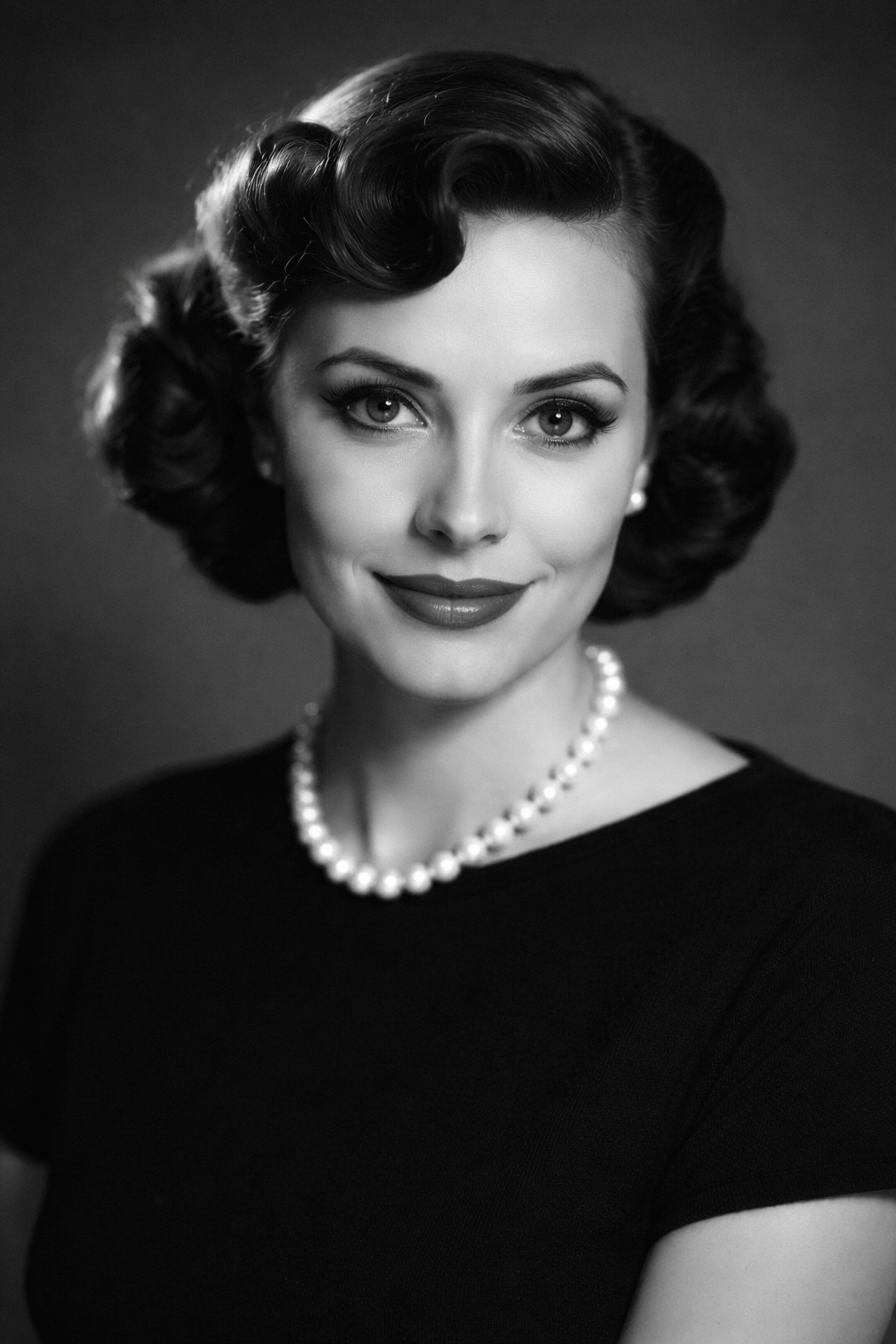
What follows are Eleanor's recollections about childhood, where she came from, her earliest memories, and the people who shaped her.
I want you to know where I came from. I grew up in a small farmhouse in Vermont, where the winters were long but our kitchen was always warm. My mother would wake before dawn to start the woodstove, and by the time my sisters and I came downstairs, the whole house smelled of coffee and fresh bread. We didn't have much, but we never knew it. The fields behind our house stretched all the way to the tree line, and in summer we'd spend entire days out there, catching frogs in the creek and racing each other to the old oak. That farmhouse shaped everything about how I think a home is supposed to feel. Not perfect. Not grand. Just warm, and full, and always open.
My father's hands. He was a dairy farmer and his hands were always rough from the cold and the work, but when he held my hand walking across the yard to the barn in the dark before sunrise, I couldn't have been older than four, I felt entirely safe. The barn was warm and it smelled of hay and the cows, and he'd let me sit up on a stool and watch the morning milking. I don't think I understood then that I was watching my father do something hard and essential. I just knew it was peaceful, and that he let me be there with him.
Busy and close. My father farmed; my mother kept everything running. There were five of us children, Ruth, me, Patsy, and the two boys, Charlie and Ed. We worked alongside our parents when there was work to be done, which was most of the time. Nobody talked about feelings much, but you always knew where you stood with people. If someone was sick, you sat with them. If someone needed help, you helped. That was just understood, and I've never lost that understanding.
My mother, Lillian, first and always. She was the kind of woman who could make a meal out of almost nothing and make everyone at the table feel like they'd been given a feast. She didn't complain. She worked, she sang while she worked, and she noticed things about people that nobody else noticed. I learned from her that taking care of someone is a skill, maybe the most important skill there is, and that it deserves to be taken seriously. My sisters Ruth and Patsy were my first friends and my longest ones. We shared a room our whole childhood, sometimes a bed in the coldest months, and we knew each other in the way only people who have grown up under the same roof can know each other. And there was my third-grade teacher, Miss Aldrich, who told my mother I had a gift for listening. I don't know if that was exactly a gift, but I've tried to make it one.
In Eleanor's own words.
Sixteen, seventeen: I was still on the farm in Vermont, still the second daughter of five children, which meant I'd long since learned to occupy the particular position of someone who is neither the oldest nor the youngest, who watches more than she leads, who gets good at reading the room and knowing when to speak and when to let things be. I don't think I was especially interesting on the outside. I worked. I helped with the younger ones. I went to school and did well enough but never in ways that drew attention. What my closest friends from that time would probably say is that I was reliable. That I kept my word, that you could tell me something and I would hold it, that I didn't talk about people unkindly. I wasn't flashy or ambitious in any outward way. What I wanted, even then, was what I eventually got: a life I could trust, people I could count on, a place I recognized as mine. I didn't know to call that an ambition. I know now that it is.
I wanted a home and a family of my own. I knew it, and I didn't apologize for it, though later I sometimes felt I was supposed to. My mother had made our farmhouse feel like the center of everything, warm and alive and always open, and what I dreamed of, if I'm honest, was building that for someone else. Not because I had no other ambitions but because I understood that kind of home as a serious thing, a thing worth making. I've had people ask me over the years whether I wished I'd done more, gone further, been something in addition to what I was. The honest answer is no. The life I built was the one I meant to build. I raised four children who are good people. I kept a house that people came to on their own, without being asked. I ran the harvest supper for twenty-eight years. I was in the middle of things that mattered to me. What I dreamed of, I came to. That's not nothing. It's quite a lot.
His name was Thomas Mitchell, and I met him the summer I turned twenty, when his family moved to our town and he came to help his uncle repair the fence line that bordered our property. I was aware of him for two weeks before he spoke to me. He was quiet and steady and careful with tools, which I noticed because it is not as common as it should be. We were married two years later, and for the next fifty years I never had cause to regret it. He was the person I grew into adulthood with, which means he knew me before I was fully formed and loved me anyway, and I did the same for him. I don't know how to talk about him without him being the whole of the story. He was, for most of my life, the story. I still talk to him sometimes, out loud, in the kitchen in the morning. I'm not embarrassed about that.
The morning Thomas and I moved into our first house. It was a small place, older than either of us, in need of more work than we had money to do immediately, and it was ours. I remember standing in the empty kitchen, which smelled of dust and old wood and possibility, and thinking: I am going to make this a home. Not my mother's home. Not the house I grew up in. Mine. I was twenty-two years old and I had a kitchen with unreliable heat and a floor that tilted slightly toward the back door and not a single thing on the walls, and I had never felt more capable or more free. Thomas was outside unloading the truck. I stood in that kitchen by myself for a few minutes and just looked at it, all that blank space waiting to become something. I have thought about that morning at intervals my whole life since. The particular feeling of an empty room that is entirely your own.
This is Eleanor's account of the life she built, the work she did, the risks she took, the hardest chapters, and the moments she would return to if she could.
I raised four children, Susan, Paul, Maggie, and Anne, and I was a wife to Thomas for forty-three years, and I was what people in our town called a neighbor, which meant something specific there: you showed up. You brought food when there was illness. You organized the harvest supper. You drove the older women to their appointments when they couldn't drive themselves. I helped run the quilting circle at the church for almost thirty years, and I volunteered with Meals on Wheels until my knees wouldn't cooperate anymore. People sometimes used to ask me if I wished I'd had a career, and my honest answer was always no. Not because careers aren't worth having, I watched my daughters build theirs and felt nothing but pride. But because the work I did felt necessary in a way I understood. Someone had to hold the center. I was glad to be the one who did it.
I said yes when Thomas asked me to marry him, and I was only twenty-two and hadn't seen much of the world yet. My mother thought I might be rushing. I wasn't. He was the steadiest, kindest man I'd ever met, and I knew it. The other risk I'm glad I took was smaller but felt large at the time: in 1987, I stood up at a town meeting and argued against a proposal that would have changed the character of our community in ways I thought we'd regret. I'd never spoken publicly before. My voice shook the whole time. But I made my case, and people listened, and the measure failed. Afterward, an old farmer named Mr. Harrington shook my hand and said, "You were right, and you had the nerve to say so." That meant more to me than he knew.
Thomas had a stroke in the winter of 2008. He was sixty-three. He survived it, but he was never quite the same man afterward, the words came slower, the hand that had spent forty years building things in his workshop couldn't do the work it used to do. We had two years together after that, and they were hard years, but they were also years I wouldn't trade. I learned things about love in those two years that I hadn't known in the forty that came before. He died in March of 2010, on a Tuesday morning, with all four of the children in the house. I got through it the way you get through anything: one day at a time, and with help. The church helped. Ruth helped. Susan and Maggie drove up from Connecticut every other weekend for months. And I kept cooking, I don't know why, but keeping the kitchen going felt like holding on to something true. The house still smelled like a home. That mattered.
The summer all four children were still at home, I think it was around 1979, Susan was fifteen, Paul twelve, Maggie nine, Anne six. Thomas was building a back porch for us, and the children would come out after supper to watch his progress and hand him tools and mostly get in the way, and he would explain what he was doing to each of them with such patience. I'd sit on the steps with my coffee and watch them all in the long summer light, and I'd think: this is it. This is the thing I'll look back on. I was right.
Here, Eleanor speaks about the people who mattered most, those who loved her, shaped her, and who she most wanted to say something to.
Thomas shaped me most. Not by telling me what to think or who to be, he wasn't that kind of person, but by being so consistently himself that I felt free to be consistently myself. He didn't need me to be anything other than what I was. In fifty years of knowing him I never once felt like I was performing. That's a rare gift to give someone. I hope I gave it back. My mother shaped who I knew how to be in a house. Thomas shaped who I was allowed to be in the world.
Miss Aldrich, my third-grade teacher in Barnard. She wrote something in my report card once, I still have it, somewhere in the cedar chest, something about how I had a gift for making other children feel at ease. I was eight years old. I hadn't thought of myself as someone who had gifts. I've thought about that ever since. I never went back to tell her what that meant. I've thought often about the small sentences that change a child's idea of herself. I hope I said a few of those to my own children without knowing it.
My sister Ruth, who has never once in her life made me feel like an imposition. There is something about a sibling who knew you before you had any idea who you were going to be. She remembers the girl I was before I had to be anything in particular. I think that's why, even now, I can pick up the phone and tell her something I wouldn't say to anyone else. She holds the earliest version of me, and she's never used it against me.
Susan, Paul, Maggie, Anne. And the nine grandchildren, each one a kind of miracle I didn't expect to feel so strongly about until they arrived. What I want them to know is something I've already written down and mean every word of: you were my greatest adventure and my deepest joy. The adventure of watching you become yourselves, year by year, that was the thing I lived for. I also want them to know that their father would be so proud. He loved them in a quieter way than I did, he showed it through what he built, through what he fixed, through the way he always had time when they needed him. I've tried to keep saying his name so he doesn't become a memory too soon.
What follows is Eleanor's hard-won wisdom, the things she learned about life, about people, and about what actually matters, that took a lifetime to arrive at.
That you don't have to earn rest. I spent years feeling vaguely guilty for sitting still, for reading in the afternoon, for not always being productive. I thought worthiness had to be worked for every day. It doesn't. You are allowed to simply exist sometimes. You are allowed to sit in the garden and watch the bees and do nothing of practical use. I didn't fully believe that until I was in my sixties, and I wish I'd had those earlier years back.
That most people are lonely in some way they haven't said out loud, and that being genuinely seen by another person is one of the things human beings need most. I've watched this for eighty years. The people who are difficult are almost always the ones who feel unseen, the ones who soften when you give them a little time and attention. I try to give it whenever I can.
Pay attention. To the people in front of you, to the season you're in, to what a day actually holds. Most of life is not the big moments, it's the ordinary ones, and whether you were awake to them. Feed people. Say what you mean. Don't save the good dishes for company that never comes. Be easier on yourself than your mother probably was on herself.
What matters: being present with the people you love. Having a warm place where people feel welcome. Keeping your word. Knowing your neighbors. Growing something, a garden, a child, a friendship. What doesn't matter: what your house looks like compared to someone else's. Whether you were always right. What people who didn't know you well thought of you. Most of the things I wasted worry on turn out to have belonged in this category.
These are the moments Eleanor was most proud of, not by anyone else's measure, but by her own.
The harvest supper. For twenty-eight years I organized the harvest supper at our church, and every year we fed the whole town and raised money for families who were struggling, and for one evening everyone sat down together, the old families and the new ones, the people who agreed about nothing, and ate. I'm proud of that. I'm proud that it happened every year because enough people believed it mattered, and because I kept believing it mattered even in the years when it felt like a lot of work for one night. And I'm proud of my children. Not of their accomplishments, though those are real, but of who they are to each other. They still call each other. They still show up. That's the thing Thomas and I were most trying to build, and it held.
In 1987, I stood up at a town meeting and argued against a proposal that would have changed the character of our community. I'd never spoken publicly before. My voice shook the whole time. But I made my case, and people listened, and the measure failed. Afterward, an old farmer named Mr. Harrington shook my hand and said, "You were right, and you had the nerve to say so." That surprised me, I hadn't thought of myself as someone with nerve. I've tried to live up to it since.
The harvest supper, and what it represented. For twenty-eight years, one evening each fall, the whole town came together. The supper outlasted disagreements, hard winters, changes in the community. I didn't build it alone, but I kept it going, and I'm glad I did. You don't need your name attached to something for it to be yours. You just need to have cared for it long enough that it became part of you.
You were my greatest adventure and my deepest joy. Carry our memories forward, but don't live in them. I want you to make new ones, ones that are entirely your own. And when you miss me, come here, to the table, to the kitchen, to the place where we always gathered. I'll be right where I always was: in the middle of the people I love most. Susan, you are the one who taught me that strength doesn't have to announce itself. Paul, you have your father's hands and his patience, and that has always made me glad. Maggie, you are more like me than you probably want to know, and that has always made me proud. Anne, you were the last one home and you filled the house with something the rest of us hadn't known it was missing.
The belief that a table is more than furniture. That gathering people around it, for no reason, for every reason, is one of the most important things a person can do. Carry that forward. Keep the table full. And carry forward the knowledge that ordinary things, done with love and consistency, add up to something. A life doesn't have to be dramatic to be meaningful. Most of the best ones aren't.
I felt, most of the time, exactly where I was supposed to be. That's not a small thing. Lots of people spend their whole lives looking for that feeling and never find it. I found it early, in this state, in this town, in this family, and I held on to it, and it held on to me. I was happy. More often than not, and more deeply than I probably ever said out loud, I was happy.
What follows are Eleanor's words about how she wants to be remembered, written directly to the people who will one day read this page.
As someone who kept a warm house. As a woman who showed up. As someone who made you feel, when you sat at her table, that you were exactly the person she'd been hoping to see.
The thing I most want you to know is the way you feel when you come in from the cold, that particular feeling, the warmth and the welcome, the smell of something in the oven, the light on in the window. If that's what they feel when they think of me, then I did what I set out to do.
Five moments that defined an era, seen through Eleanor’s eyes.
We were not a family that talked about fear openly, but polio was a fear that lived in the background of my early childhood like weather. Every summer there were cases, and every summer parents were careful, watchful, ready to pull children back from the swimming hole or the town pool if anything seemed wrong. I didn't fully understand it. I just understood that certain things could happen, and that parents worried about them in a way they tried not to show. When the vaccine was announced, I remember my mother sitting down at the kitchen table in the middle of the morning, which she almost never did. She sat down and folded her hands and was quiet for a moment. Then she said, "Lillian," which was her own mother's name, and then she didn't say anything else for a while. I think she was talking to her mother, who had raised children in the era before the vaccine, who had watched children die of things we now consider history. I still think of that moment when I hear people dismiss what medical progress means. It meant my mother could stop being afraid. It meant we could go swimming again without guilt. That was everything.
I was eighteen and working a part-time job at the general store in town. The radio was on, and when the news came through, the man behind the counter turned it up and we all stood and listened. I remember a woman near me starting to cry and not knowing what to do with her hands. What I remember most about that afternoon was walking home. It was late November, cold and clear, the trees bare, the road familiar. I'd walked it a hundred times. But that day it felt different, the same and different at once, the way a place looks when you know something about the world that you didn't know when you last walked through it. I'd voted in my first election the year before, Kennedy's election, because the primary was after my eighteenth birthday. I had voted for him and felt, for the first time, like the country was something I was a part of. And then he was gone. Some griefs are too large for the person you were when you felt them.
I was twenty-four and Susan was two years old, and Thomas had put our little television on the kitchen counter so we could watch while I got Susan ready for bed. She didn't know what was happening. She was two. But Thomas and I sat up late watching after she was asleep, on the couch with the sound turned low so she wouldn't wake. What I remember is that Thomas was quiet for a long time after Armstrong stepped onto the surface. He wasn't a person who talked much about things that moved him; he showed those things through his actions, not his words. But after a while he said something I've never forgotten. He said, "I hope she grows up knowing there's no limit to it." He meant Susan. He meant the world, the possibilities. He was speaking to me but also, in that way of his, to the future. That moment is as much a memory of Thomas as it is of the moon. The two are tied together in my mind, and I'm glad of that.
I watched the news with Thomas that November night, the images of people on top of the wall with hammers and their bare hands, passing each other back and forth over something that had been, the day before, impassable. I kept thinking about what that took, not the hammer, but the belief that you were allowed to. That the wall was yours to tear down. I hadn't lived my life thinking much about the Cold War as a personal thing. It was background, something you grew up with, like weather. But watching those people I understood for the first time what it meant to have lived under that wall, and what it meant to know it was over. Thomas said something about the children who'd grown up in its shadow and were watching it come down. He thought about things like that. We stayed up late watching. It was one of those nights you know, while it's happening, that you'll remember. I want to say the world felt lighter afterward. I think it did.
I was making bread. I had the radio on in the kitchen, and the bulletin came through, and I stood at the counter with my hands in the dough and could not quite understand what I was hearing. I turned off the radio and turned on the television, which I almost never did in the morning, and then I didn't move for a long time. Thomas was in his workshop. I went to get him and we stood together in the kitchen watching, not saying much. There wasn't much to say. The children called, one by one, through the morning: Susan first, then Paul, then Maggie, then Anne. Each call was a small relief. They were all right. They were where they were supposed to be. What I remember most, beyond the images, is the particular quiet that settled over the town. People came out of their houses and stood in their yards. I went to the church in the afternoon because I didn't know where else to go, and the pews were full of people who didn't know where else to go either. We sat together in the ordinary silence of a place built for exactly that, to hold people when things fall apart, and it held us.
“Every year, the week before the harvest supper, Mom would be up by five. Not because she had to be , she'd been running that supper for so long she could have done it in her sleep , but because she loved the preparing of it as much as the night itself. She'd have lists on the counter, pies cooling on the rack, and she'd be humming something under her breath, some hymn she probably didn't even realize she was singing. When I was a teenager I found this mildly embarrassing. When I was in my thirties with children of my own, I understood that I was watching someone who had figured out how to be exactly where they wanted to be. I've spent my whole adult life trying to learn what she already knew.”
“What I want my own children to understand about their grandmother is this: she made every person who came into her house feel like the visit mattered. Not with grand gestures. With a cup of tea that appeared before you asked for it, with the particular way she looked at you when you were talking , fully, with both eyes, as if there were nowhere else she'd rather be. That's not a small thing. In fact, I've come to think it may be the largest thing a person can give another person. She gave it freely, her whole life long.”
“I want to tell you something about Eleanor that her family may not have known, because she was not a woman who talked about herself. For three years running , I know because I was keeping track , she quietly paid the entry fees for two younger women in our circle who couldn't afford them. She never mentioned it. I only found out because one of the women told me years later, with tears in her eyes. That was Eleanor. She didn't do kind things to be seen doing them. She did them because they needed doing and she was there.”
“At our last meeting before she moved in with Susan, she finished the border on a quilt she'd been working on for her youngest granddaughter. Her hands weren't what they used to be by then, but she sat with it for two hours and got it done. When someone asked if she needed help, she looked up and said, "I'll ask when I do." That was her whole philosophy in six words. I've thought about it every week since.”
“I was about eight the summer Grandma taught me to make pie crust. She had strong opinions about pie crust , cold butter, cold hands, no overworking , and she communicated these opinions very seriously, as if the fate of something important depended on getting it right. I ruined the first one completely. She looked at it, nodded once, and said, "Good. Now you know what not to do. That's worth more than getting it right the first time." I use that line with my own kids now. I use it at work. I'm not sure Grandma knew she was teaching me something about more than pie, but she was.”
“Her kitchen smelled like woodsmoke and cinnamon and something I've never been able to name but would recognize anywhere. When I drove up for her eightieth birthday, I walked in the door and the smell hit me and I was eight years old again. I stood in the hallway for a moment and didn't want to move. That farmhouse was always the same. She was always the same. In a life that changes fast and often, that kind of constancy is something you hold onto. I'm holding onto it now.”
Leave a message for Eleanor’s family
Eleanor wrote this page in her own words.